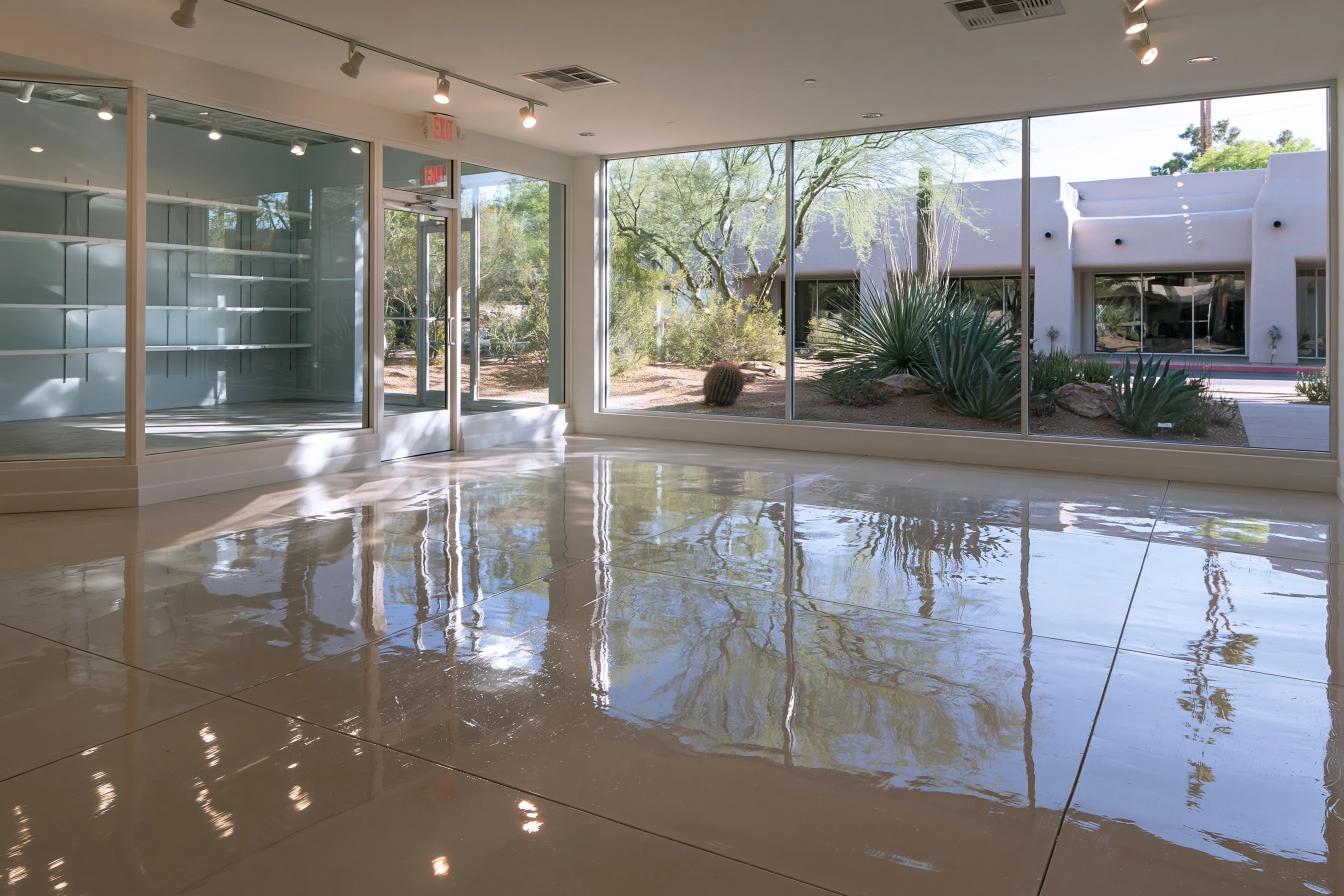
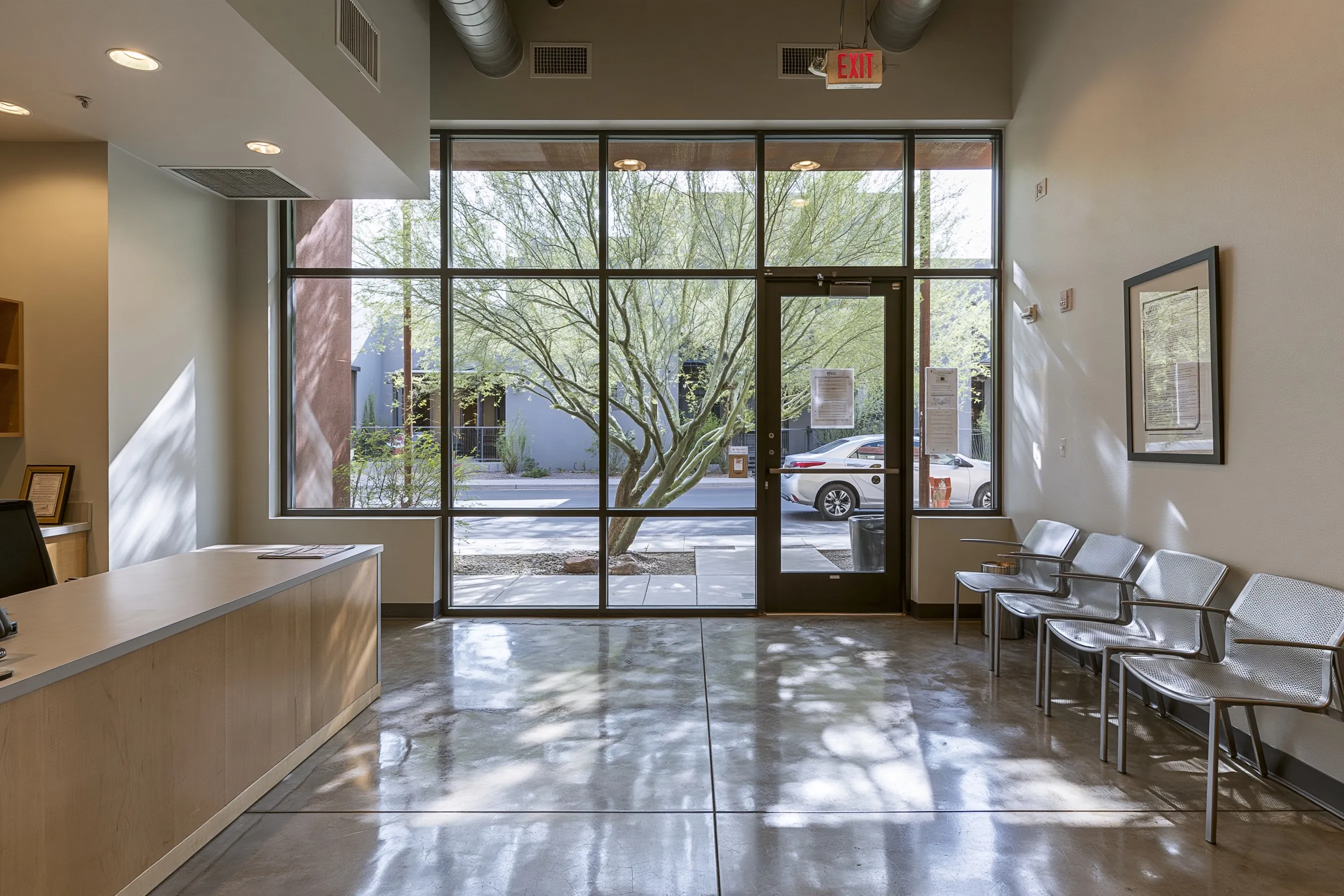
Avondale Polished Concrete polishes commercial concrete floors in Avondale: retail units, showrooms, offices, restaurants, workshops and warehouses. A business floor has a different brief from a house, with tenants or staff to work around, a spec or lease to meet and a reopening date, so the plan starts with how the space is used and ends with a finish level that suits it.
We work on tenant improvements over an existing slab and on new slabs, for owners, property managers and general contractors. Our service area includes Avondale and the neighbouring cities of Goodyear and Tolleson.
Customer-facing floors usually call for an even, higher-sheen look that reflects light and stands up to foot traffic. Gloss and slip behaviour are weighed together, and an entrance gets different treatment from a display area.
Offices and reception areas
Satin or polished concrete in a lobby or open office runs through the space without seams. Walls, columns and door thresholds are finished by hand, and those edges can read differently from the main floor, so look at them on the test area before approving the finish.
Workshops and back-of-house areas
Floors that see machinery, carts or chemicals may suit a lower-sheen finish or a different system. We say plainly where polished concrete is not the right tool, such as areas with predictable chemical exposure.
Warehouse and storage floors
A large floor is a question of scope and sequence: area per day, how racking is moved, and where joints and cracks fall. A test area shows the finish before the whole floor is committed.
Specifications and test areas
The reference specification for polished slab finishes is ACI 310.1-20. It covers the test area (mockup), grinding, honing, clarity of reflected images, haze and edge polishing, and it requires a Mohs surface hardness greater than 4 before polishing. Where a design calls for a spec, we price to it and build the test area on the actual slab.
The Concrete Polishing Council’s chart describes three aggregate looks, cream, salt-and-pepper and full aggregate, and measures the result in a random 10 foot by 10 foot square. The look depends on the mix and on how the slab was placed and finished, and flatness matters, so ask the designer for the specified FF and FL numbers. The council recommends overall FF 50 and FL 30 for floors to be polished, with local values of 35 and 20.
A tenant improvement usually means polishing the slab that is already there. Coverings, glue, old coatings and joint repairs have to be dealt with first, and a floor that never had a vapor barrier under it can show moisture-driven color variation. On a new slab, the concrete should be cured at least 28 days before polishing, a vapor barrier of 15 mil is preferred, and the mix and curing compounds should be agreed with the polisher because they can change color and slow drying.
The slab should also be protected during construction: no storage on it, no tape on the surface and no unprotected steel wheels. Whether the floor is polished before or after the walls go up is a decision to make early, since hand-polished edges next to finished walls look different.
Grinding concrete throws silica dust. OSHA’s construction silica standard (Table 1) gives two options for walk-behind floor grinders: water supplied continuously at the cutting surface, or a dust collector the machine maker recommends, with a 99 percent filter and a filter-cleaning feature. Indoors, loose dust is vacuumed with a HEPA-filtered unit between passes. A commercial job should be scoped around one of those methods and the machine maker’s instructions.
The job is also phased around the business. Sections of a floor can be done while others stay open, noisy passes can be separated from opening hours, and the finished floor needs protecting from other trades. We confirm the order of work with you before it starts and give no fixed duration before seeing the floor.
Levels run from flat (ground) through satin and polished to high polish, but shine is not a measure of grip. Water, oil and grease can make polished concrete slippery. Where customers or staff walk in on wet shoes, such as an entrance or a wash-up area, we would pick a lower sheen, put mats down and want the finish slip-tested before it is chosen.
In an older building, vinyl tile and black mastic under the carpet can contain asbestos and should be tested before grinding. In Maricopa County, a building used for commercial, institutional or industrial purposes counts as a facility under the asbestos rules, and resilient floor covering that will be ground can be regulated. The county’s handbook explains when an inspection and notification are needed. This is not legal advice, so check with the Maricopa County Air Quality Department.
Usually the slab under tile or carpet can be exposed and polished. The surface hardness, cracks, joints, old adhesive and moisture decide the result, and a test area on the actual slab shows it.
How long will the floor be out of use?
It depends on the area, the amount of removal and repair, and the finish level. We plan phases around your hours and agree them in advance rather than promising a number before seeing the floor.
Does polished concrete need a sealer?
A densifier makes the slab less permeable, so a sealer is not required for the floor to work. A guard or stain protector is often added as a last step, and some floors are left without one. We recommend one based on how the floor is used.
Tell us what the space is used for, the approximate floor area, what is on the floor now and when it has to reopen. If there is a specification or a general contractor involved, say so. We'll get back to you soon with an estimate or any questions we have. Estimates are free and there's no obligation.