Avondale Polished Concrete polishes concrete floors in Goodyear, from garages and great rooms in newer houses to small business floors, with stained and dyed color, slab restoration and grind and seal as options. Polishing refines the slab itself, so what you get depends on the slab you have.
Goodyear sits west of Avondale, roughly four driving miles from city hall to city hall. About 78 percent of its homes went up in 2000 or later, the median year built is 2007 and about 86 percent are single-family houses, so builder-grade slabs and big garages are the floors in question more than old coverings.
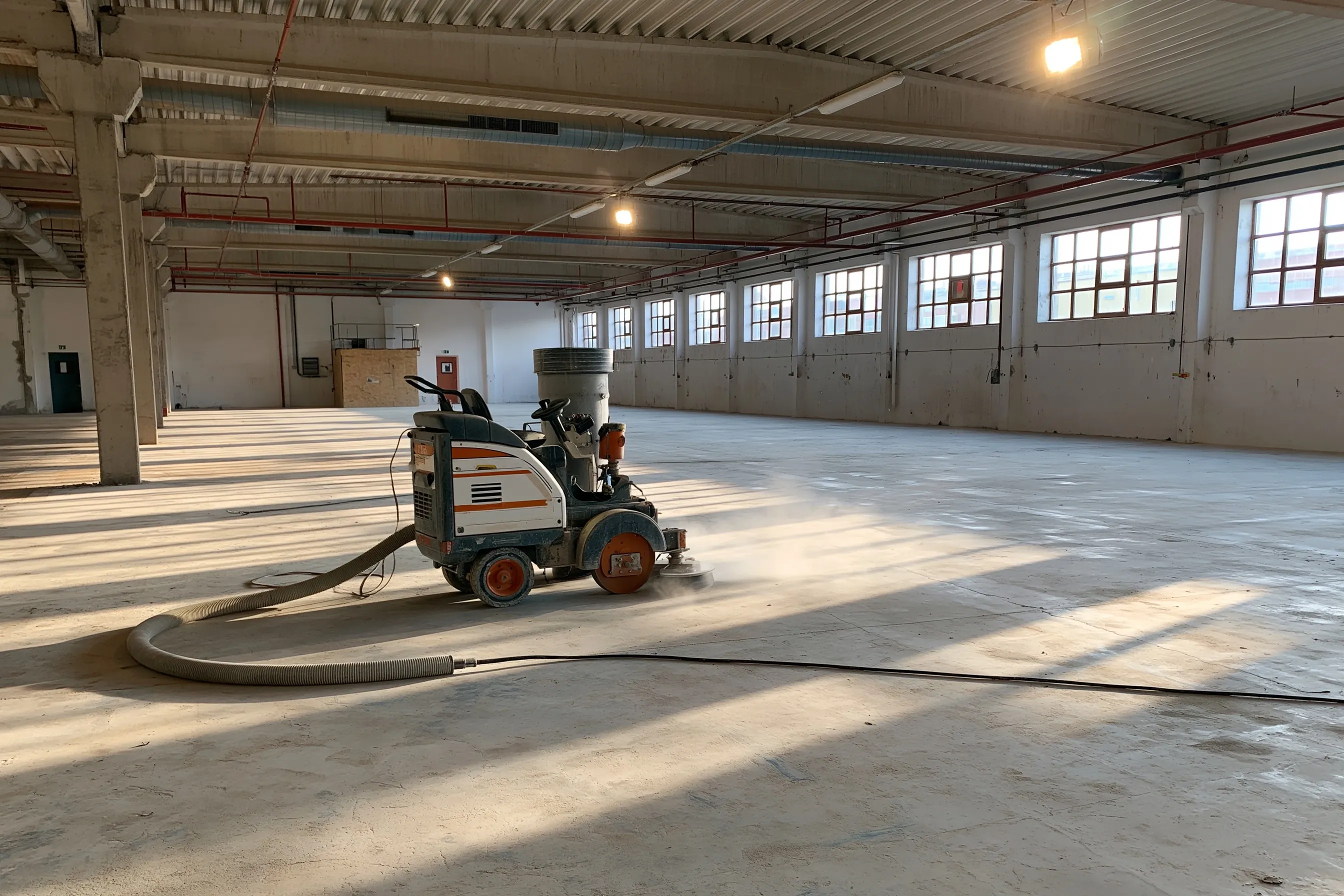
Empty industrial building in Goodyear with tall windows on one wall
Original request
A sealed floor that stays dust-free for a storage tenant
Floor
About 6,000 sq ft of bare gray slab
Finish
Ground flat and sealed, no polish
Equipment
A walk-behind grinder with a dust hose
Estimated cost
$14,400
In this example, a company is taking an empty industrial building in Goodyear for storage. The concrete is bare, dusty and uneven in places, and the tenant wants it sealed before the racking goes in.
With so many houses built in the 2000s and 2010s, garage slabs are a common first project here. A garage can be polished and dyed or sealed, and our garage page compares polishing with a coating. See polished concrete garage floors.
Great rooms and kitchens
Where a builder floor of carpet or tile is going, the slab can be exposed and polished or sealed. Color can go in as dye. See stained and dyed concrete floors.
Small business floors
Offices, shops and showrooms in newer buildings often have new slabs, where cure time, mix and the vapor barrier matter. See commercial polished concrete.
Housing here is among the newest in the west valley: about 4 percent of homes predate 1980, about 17 percent are from 1980 to 1999 and about 78 percent from 2000 on, including roughly 40 percent from 2010 or later. A young slab behaves differently from an old one. It is less likely to carry old adhesive and more likely to be plain builder concrete that was never designed with polishing in mind.
Commercial specifications call for a new slab to be cured at least 28 days before polishing, a requirement taken from a contractor bulletin rather than a residential rule. For a newer house, ask the builder about the cure and mix, since a builder’s mix, curing compound or finishing can change how the color comes out. A test area is the way to find out.
Whether a floor project needs a permit depends on the work. Ask the City of Goodyear building department before any cutting, structural repair or work that touches the structure, since we have not confirmed what the city exempts. Goodyear is in Maricopa County, whose asbestos handbook covers commercial, institutional and industrial buildings and residential buildings used for those purposes; an owner-occupied residential parcel with four or fewer dwelling units is not a facility under it.
Under Arizona law a contractor needs a Registrar of Contractors license once a job passes a small-job limit, so look up the license on the ROC site before agreeing to any work.
Can the builder’s slab in a newer Goodyear house be polished?
Often it can, if the surface is hard enough. The slab may not have been poured with polishing in mind, so a test area shows how the mix and finish take it.
Do I need to wait after a new build?
Commercial specifications call for at least 28 days of cure before polishing. For a new house, ask your builder about the mix and curing.
Can my garage floor be polished?
Yes, and it can be dyed or sealed. Joints and cracks stay visible. Our garage page covers polished concrete versus epoxy.
Goodyear address, new or older house, and the rooms or garage you want done: send us those and we will reply with a quote. We'll get back to you soon with an estimate or any questions we have. Estimates are free and there's no obligation.